Sunday, January 3, 2016

2015 Japan Autumn Trip 04: Fushimi Inari Shrine and Senbon-torii (Thousands of Torii)

Lets go to Fushimi Inari Shrine (伏見稲荷神社) today! This was the place where foreigners liked the most in Japan. (Accodring to the survey conducted by tripadvisor in 2015). So lets take a look how special it is. (By the way, I have one of the most unforgettable experiences in my trip right here too!)


Outside Inari Station. Red huge torii could be viewed from the station.

The pathway towards ni-no-torii (二の鳥居) and rou-mon (楼門, Two-storied Gate)

Small shrines at the side of pathway

Rou-mon, built by Toyotomi Hideyoshi in 1589, to pray for his mother's health.

Saturday, January 2, 2016

2015 Japan Autumn Trip 03: Kasuga-Taisha Shrine

Heading south from Tamukeyama Shrine (手向山神社), you will reach another major tourist spot in Nara, Kasuga Taisha (春日大社, or Kasuga Grand Shrine).

First you will pass through Mt. Wakakusa (若草山). This small hill, which covered by sheets of grass, is recognized as one of the new three major night view of Japan. You could have a nice night view of Nara if you are on top of it. During Edo period, it was famous with its Mikasayama-yuki (三笠山雪, snowy Mt. Mikasa) and listed as one of the Eight Views of Southern Capital (南都八景). This is also the place that held the famous burning-hill ceremony (山焼き) in every January.


The hilltop was covered by thick mist. It looks like the heaven is just a few steps away.

Friday, January 1, 2016

2015 Japan Autumn Trip 02: Autumn Look of Todai-ji, Nara

A lot of Buddhism temples are still well preserved currently in Nara city, an imperial capital about 1300 years ago. This is my second times visiting this city. I had visited Kofuku-ji and Todai-ji these two temples early this year. So, if you are interested in their history and how the sakura blooming in these two temples, please kindly refer to the link provided. :)

This post will let you experience the scenic red leaves from Nara station to Todai-ji, and Nigatsu-do, a temple hall located at the east of Todai-ji where you could see the entire view of Nara city.

Outside Nara station, few days ago was Ritual of Returning to Main Hall (正迁宫祭) of Kasuga Taisha

Red leaves along Sanjyo-dori street

Jokyo-ji, a temple hidden in modern buildings along Sanjyo-dori

Red leaves outside Kofuku-ji

Tuesday, July 21, 2015

2015 Taiwan Summer Trip 10: New Taipei City Gold Museum, the Golden Age of Jinguashi

After having breakfast at second day at Jioufen, we started our journey of searching gold.


The breakfast cooked by the homestay owner herself

After leaving from the entrance of Jioufen Old Street, we took bus from the opposite bus station to Gold Museum at Jinguashi. The road to Jinguashi is very narrow, sometimes the driver need to let the vehicles at opposite way to pass through first.
  
Entrance of Gold Museum

Monday, July 20, 2015

2015 Taiwan Summer Trip 09: Lively Jioufen Old Street, Enjoy Tea at Amei Teahouse

After taking ferry from Green Island back to Taitung, we then took Puyuma Express, a new express train which operates at east coast of Taiwan, from Taitung to Songshan. It was another 3 hour and 22 minute train. Since we arrived at Taiwan, we had traveled around the whole island. 


Outside Taitung Station


The aboriginal sculpture at ticket entrance

Sunday, July 19, 2015

2015 Taiwan Summer Trip 08: Astonishing Scenery and Seaweed Food at Green Island

On the second day at Green Island, we had our lunch at a restaurant called "18 Haili". The food was quite nice compared with the braised rice (or Huifan in Mandarin) bought the day before. There is a large window facing towards the sea in the restaurant. Customers could enjoy their meals and the beautiful sea view at the same time.


18 Haili Restaurant


Peanut Tofu (highly recommended), it tastes like yam cake in Malaysia or Singapore, the meat paste is made by deer meat (I did not intend to eat it, but only realized after tasted....)


Fried egg with seaweed, it's so huge in size and what we ordered was small one

Saturday, July 18, 2015

2015 Taiwan Summer Trip 07: The Prisons of White Terror, New Life Correction Center and Oasis Villa

At the morning of second day on Green Island, my brother and I went for snorkeling. This is the second times I snorkeled, the last times was 9 years ago at Redang Island. Compared with the snorkeling at Redang, it is required to wear diving suit and boots here. The snorkeling area was just at sea shore, so we walked into the sea directly. In Redang, we need to take ferry to an area further away from the Island for snorkeling.

The snorkeling was quite nice. The fishes were so colorful. One of them was so special with its long tip at its head. The coach let us to feed those fishes with bread. Those fishes just hurried to our surroundings once the bread drop into sea. They moved so fast till I couldn't see them clearly. However, it must be careful to feed them as their teeth were quite sharp. My brother's finger was hurt when feeding them. For the corals, it isn't pretty as what I imagined.

After lunch, we started to explore each interesting sites on the island. Due to the overwhelming number of sites, two posts will be used to describe these places. The first one is about the Green Island under White Terror, while the second one is about the natural scenery of the island.

Green Island is one of the offshore islands at east side of Taiwan. It was used as prisons to imprison political inmates during the reign of Martial Law (1974 - 1987). During this 38 years of rule by White Terror, two political prisons were set up in this island. The first one was the New Life Correction Center (1951 - 1965), operated by the Taiwan Security Command, while the second prison was the Ministry of National Defense Green Island Reform and Reeducation Prison (1972 - 1987), also known as Oasis Villa.

Oasis Villa Rock, behind was Elephant's Trunk Rock, or known as "Devil's Gate" by the prisoners during the period of New Life Correction Center. There was a checkpoint set between these two rocks. The prisoners must pass the checkpoint first before entering the area of New Life Correction Center. Since there was almost no hope to be released, the prisoners treated the checkpoint as a gate to death.

Friday, July 17, 2015

2015 Taiwan Summer Trip 06: Long Journey to Taitung, Night Travel at Green Island

Our next destination was Green Island. We came to Tainan Train Station early in the morning to take a 3 hours and 11 mins train to Taitung.

Tainan Train Station at 5:56 am

Train route from Tainan to Taitung, which traveled across the southern Taiwan. Green Island is opposite of Taitung.

After passes through Fangshan Station, which is the most southern station at west coast of Taiwan, the train will pass through Central Mountain Range. Tunnels and forests are everywhere along the railway and its surroundings are devoid of people. The next station is Guzhuang Station, the most southern station at east coast of Taiwan. View of Pacific Ocean at right and mountain ranges with paddy fields at left could be seen after this station.

Thursday, July 16, 2015

2015 Taiwan Summer Trip 05: Fort Zeelandia and Anping Kaitai Tianhou Temple, Witness of Early Taiwan

We came to Anbei Road, then walked to Fort Zeelandia (or Anping Fort) from Gubao Street. Since vehicles are prohibited during weekend and Public Holidays at Gubao Street, so it becomes a walking street where stalls are set up along roadside. Taiwanese street food could be found here as well as various Koza (or old times in Hokkien) games, including catching small fishes, throwing small balls to get presents like toys, shooting balloons with toy gun, etc. This street is quite different from the common walking street that just selling food and souvenirs.

There is a junction if heading south along Gubao Street. Turning right from here and walking for a short distance, you will see the entrance of Fort Zeelandia. Its opposite is Anping Kaitai Tianhou Temple, the oldest Mazu-belief temple in Taiwan. (Kaitai Tianhou lit. means Empress of Heaven who blessed the early development of Taiwan) 

Gubao Street
Guancaiban (lit. Coffin Lid), a type of Taiwanese variant of bread bowl filled with corn soup. The one at right is its original look, while the one at left is its interior after lidded up the upper crust
The video that shows how Guancaiban was made:


Wednesday, July 15, 2015

2015 Taiwan Summer Trip 04: Sihcao Dajhong Temple, Temple of Zhenhai Generalissimo the First God of Taiwan

Our accommodation at Tainan was Dorm 1828, a youth hostel near Sheng-Li Campus of NCKU. It is a small but well-equipped hostel.

Layout of Triple Room


My brother's dormitory, 1st Sheng-Li Dormitory could be seen from the balcony


View from balcony


Tuesday, July 14, 2015

2015 Taiwan Summer Trip 03: National Cheng Kung University, Campus of Nature and Arts

6 June 2015 is the day that National Cheng Kung Univeristy (NCKU) held its Commencement. We visited the campus with my brother during that morning.

Museum of NCKU

NCKU was originally established under Japanese occupation in 1931 as Tainan Technical College. In 1944, its Japanese name was changed while the English name remained. After WWII, the school was renamed as Taiwan Provincial Tainan Junior College of Technology in 1946. It was upgraded to Taiwan Provincial Cheng Kung University in 1956 and then a national university as NCKU in 1971. The Museum of NCKU was one of the campus building of Tainan Technical College under Japanese occupation.

Monday, July 13, 2015

2015 Taiwan Summer Trip 02: Fo Guang Shan, Monastery of Humanistic Buddhism

We took Tze-Chiang Limited Express from Tainan Station to Jiuqutang Station. Our plan was taking bus from the bus stop opposite Jiuqutang Station to Fo Guang Shan, but it was so hot outside, so we decided to take taxi instead. 


Tze-Chiang Limited Express


Fo Guang Shan is located at Dashu District, Kaohsiung County. Pineapple and Lychee are the main local fruits of Dashu District. It was the Festival of Pineapple and Lychee during the time we went. Banners of the festival could be seen around the area and orchards of these two fruits spread across roadside.


Pineapple, covered with hats, planted at roadside


Fo Guang Shan (FGS) is the largest Buddhist monastery in Taiwan. It is founded by venerable master Hsing Yun in 1967. Currently, FGS monastery is comprised of its temple and newly established Buddha Memorial Center. We visited the latter one.


Fo Guang Shan viewed from Provincial Highway, the standing Buddha statue is at the south side of the temple


The north side of Fo Guang Shan Temple

Saturday, July 11, 2015

2015 Taiwan Summer Trip 01: Arrived at Tainan

This is my second trip to Taiwan since last year. My brother had his graduation in this June, so my parents and I went to Taiwan again and had fun there.

We reached at Taoyuan Internatonal Airport early in the morning, then took UBUS (shuttle bus) to THSR Taoyuan Station, where we took High Speed Rail (HSR) to Tainan. Tainan is the city that my brother's university, National Cheng Kung Univeristy (NCKU) located at.


Incoming HSR
This is my second times taking HSR and experiencing its speedy operation. It took only 1.5 hours to reach Tainan, where located about 300 km away from Taoyuan. Although its ticket is about double of train ticket, it is still worthy because we save more than 2 hours on travelling.

My brother had waited at the THSR Tainan Station. Since the station is not in the city area, we had to take local train from Shalun Station, which is just next to THSR Tainan Station, to Tainan Train Station.

The totem on the floor outside Shalun Station

Saturday, May 16, 2015

2015 Japan Cherry Blossom Trip 24: Returning Home, Our First Experience of Business Class

Day 6: April 7 (Tue), Returning Home

We took Limited Express Train to Kansai Airport early in the morning. The next 2 hours in airport was just queuing. The long queue almost made us miss the flight, we entered the cabin just 2 minutes before taking off.

Today we will have our first experience of Business Class. Firstly, let me explain why we were so "rich" to take Business Class. Actually, we bought Economy Class initially, but Malaysia Airlines offered us to bid for Business Class, so we bid for SGD 200 each person for the flight bound from Osaka to Kuala Lumpur. We did not expect that we could take Business Class because the bid that we placed was actually low. However, we were so lucky at last. Haha!

Invitation card to Asuka Lounge. We were unable to go due to long queue.
The plane that we took, A330-300

2015 Japan Cherry Blossom Trip 23: Full Moon that Seems Crossing the Bridge, Togetsu Bridge

We headed south for about 700 meter after leaving from Tenryu-ji and arrived at the Togetsu Bridge, which is also a major attraction at Arashiyama. It is believed that Togetsu Bridge was built by Monk Dosho, the disciple of Master Kukai of Shingon School, in 836. The bridge receives its name when Emperor Kameyama (13th century) sang a waka (Japanese poetry) during his sailing on Katsura River. The waka writes "くまなき月の渡るに似る", which means "The night sky without clouds, Full moon seems crossing the bridge". This bridge is also a good place for viewing sakura in spring and maple in autumn.


O'i River, the section of Katsura River flows here

Mt. Arashi at far side

East view of Togetsu Bridge

2015 Japan Cherry Blossom Trip 22: A Poetic Zen Garden, Sogenchi Garden of Tenryu-ji

Well, this post is the prettiest record of flora in Sogenchi Garden.


Sogenchi Garden is the most beautiful site in Tenryu-ji. It is designed as a strolling pond garden by Muso Soseki, the Zen master who led the construction of Tenryu-ji. It employs "borrowed scenery" (shakkei) of Mt. Arashi (left), Mt. Kame and Mt. Ogura (front) and Mt. Atago (right). It also fuses the painting style of Yamato and Zen style of Song and Yuan Dynasty of China.


The pond recieved the name Sogenchi when Muso Soseki discovered a stone stele inscribed with the characters of "Sogen itteki" when removing the mud from the pond. This garden is listed as World Cultural Heritage in 1994.


Mitsuba Tsutsuji (lit. Three leaves Rhododendron)

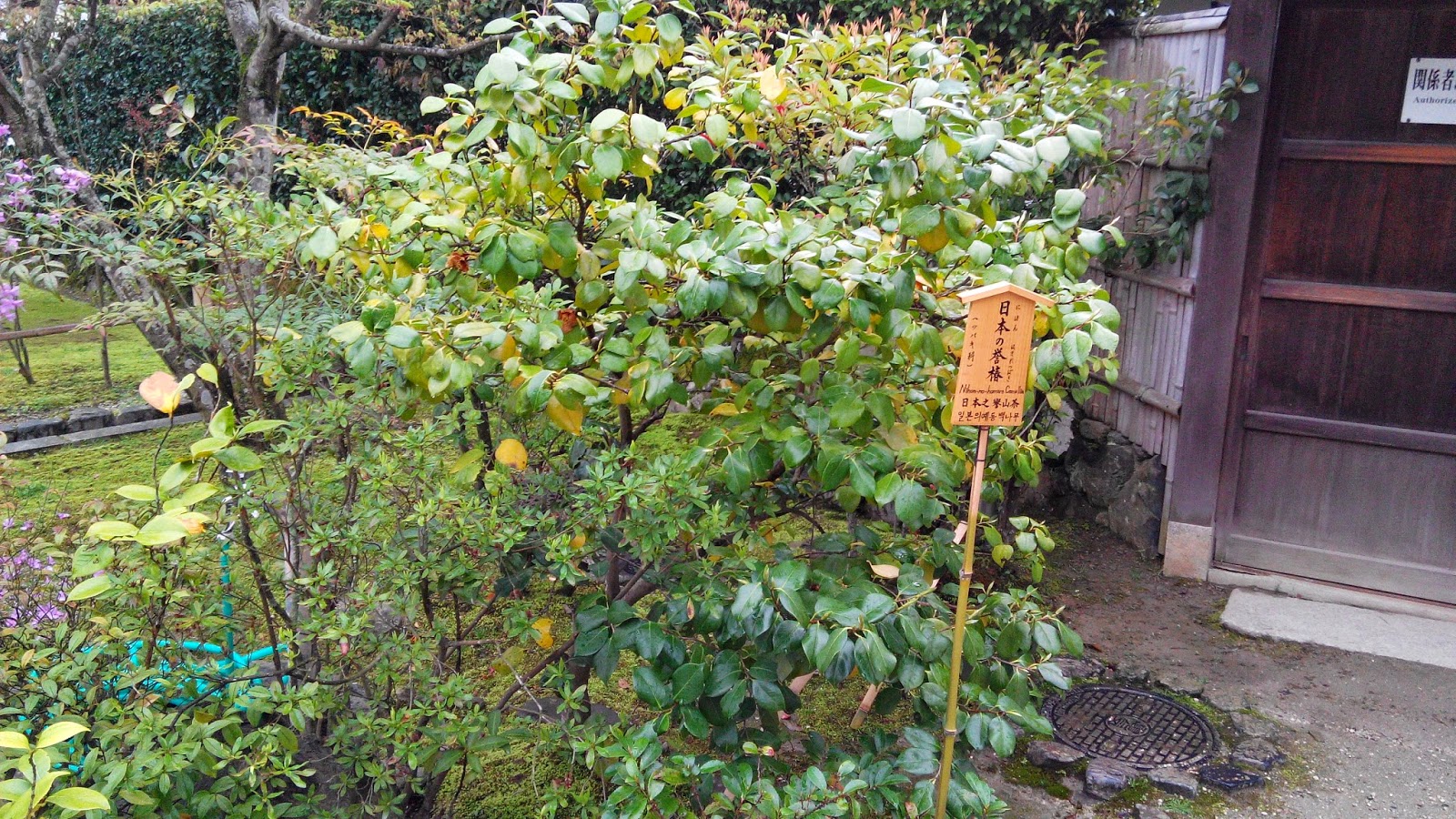
Nihon-no-homare Tsubaki (lit. Japanese Glory Camellia)

2015 Japan Cherry Blossom Trip 21: Top of the Kyoto Gozan and Head Temple of Rinzai School, Tenryu-ji Temple

We went to our last destination, Tenryu-ji Temple after Sagano Torokko Train.

Keihuku Electric Railroad Arashiyama Main Line

Randen Sagano Station

Entrance of Tenryu-ji

2015 Japan Cherry Blossom Trip 20: Sagano Torokko Train, a Trip to Hozukyo Valley


We left for Gion (祇園) after Kyoto and had dessert at Tsujiri Tea House (茶寮都路里) located at Shijyodori (四条通り). The subway was quite empty at Monday noon, which was totally different from the men-in-black in morning.
The brown building is Tsujiri Tea House